Practice —Upgrade · A practitioner's field guide
The Upgrade Method.
From the request to a change in the work. Five stages to diagnose a performance challenge and design a proportionate response, worked as a loop.
- 01ReframeTurn the request into a hypothesis.You leave withA testable hypothesis
- 02InvestigateFind the conditions behind the gap.You leave withAn evidence-informed diagnosis
- 03ProportionSize the response to the gap.You leave withA proportionate response
- 04ArchitectMatch every intervention to a cause.You leave withAn intervention architecture
- 05ProveEvidence matters more than completion.You leave withEvidence and a decision
↺ New evidence can send you back to any stage. Each loop upgrades the practice.
Builds on long-established performance consulting practice.
Before the method
Start with the work.
Performance consulting begins with what's happening in the business, and what people need to do differently to improve the outcomes that matter.
A request for training, a new tool or a better experience is a valuable place to start the conversation. The performance problem underneath it may look quite different.
The consultant's role is to listen, understand the context, establish what's known and what's uncertain, and use evidence to help people decide what needs to change before deciding how to intervene.
Four questions to open the conversation
- What's happening that's prompted this conversation?
- Why does this matter now?
- What do people need to be doing differently?
- What would tell us things have improved?
You don't need every answer before you begin. You need enough shared understanding to know what to explore next.
Enter where you are. The five stages are a way of thinking, not a checklist. If the cause is already clear, start at Proportion. If a pilot surprises you, go back to Investigate. Use judgement about what the situation needs.
Stage 01
Reframe
Turn the request into something you can test.
Requests are valuable starting points, and they often describe a solution more clearly than the problem behind it. Reframing treats the brief as a hypothesis. It carries assumptions about the problem, the cause and the fix, and each one might be right. Testing them early means whatever gets built works first time.
In practiceThe brief assumed managers lacked the skill to give feedback. That was a belief, not evidence, so it became the first thing to test.
The brief, rewritten as a hypothesis
We believe [the problem] is happening, because [the cause]. If we [the fix], we'll see [the change].
- Knownbacked by evidence
- Assumedbelieved, not yet checked
- Unknownnobody has looked
- SymptomWhat people notice
- ProblemThe gap between current and required performance
- CauseWhat creates or sustains the gap
About the problem
- What are people doing now that worries you?
- When did you last see it happen?
- What does it cost if nothing changes?
About the cause
- Who already does this well? What's different for them?
- What gets in the way, even for people who know how?
- What happens when someone gets it right?
About the fix
- What would we see people doing in 90 days?
- What's been tried before?
- What's the smallest thing we could test first?
The assumption audit. Sort every statement in the brief, then plan a test for each one that isn't known.
| Statement | Status | How to test it |
|---|---|---|
| The problem is happening | Known | Data or direct observation already shows it |
| This is the cause | Assumed | Watch the work, ask the best performer |
| Our fix will work | Assumed | Test once the cause is clear |
| What good looks like | Unknown | Ask five people for a recent example |
Treat the fix as assumed until the cause is clear. Treat the symptom as a clue, never the problem itself.
- Rewrite the brief as a hypothesis, using the sentence above.
- List every statement it makes. Mark each one known, assumed or unknown.
- Separate the symptom people notice from the performance problem underneath it.
- Pick the riskiest assumption and choose the fastest way to test it.
- Play it back: "Here's what we know, what we're assuming, and what we'll check by Friday."
AI move
Here is a brief: [paste]. List the assumptions it makes about the problem, the cause and the fix, and mark each as known, assumed or unknown.
Stage 02
Investigate
Find the conditions behind the gap.
Performance lives in an ecosystem. Causes sit in the person, in the work and in the environment around them. Evidence comes quickly when you go to the work itself.
In practiceMost managers already knew a feedback framework, so knowledge wasn't the gap. The causes were confidence, practice, the rhythm of their month and what was expected of them.
Select a cause to see how to test it.
- Sounds like
- Test it
- Where the fix sits
Where it breaks down
- Where does the work actually break down?
- What do your strongest performers do differently?
- What gets in the way, even when people know what to do?
Inside the person
- Could they explain it? (knowledge)
- Could they do it well if asked right now? (skill)
- Would they do it under pressure, with something at stake? (confidence)
Around the person
- Does the work make it easy, or get in the way?
- Is it expected, noticed and rewarded?
The performance ecosystem. Most gaps have more than one cause, and most causes sit outside the person.
| Where | Cause | The quick test |
|---|---|---|
| The person | Knowledge | Could they explain it? |
| Skill | Can they do it when asked? | |
| Confidence | Will they do it under pressure? | |
| The work | Workflow, tools, information | Watch the task. Where does it slow down or get skipped? |
| The environment | Expectations | Ask three people what good looks like |
| Managers and incentives | What happens when it's done well, or badly? |
Six fast ways to gather evidence. Most take less than a day.
- Pull the data that already exists: survey results, errors, complaints, time taken.
- Watch the work for an hour, at the point where it goes wrong.
- Hold five 15-minute conversations with the people doing the work.
- Ask for a real, recent example: a case, an email, a decision.
- Talk to the best performer about what they do differently.
- Ask a manager what they see before and after it goes well.
Record each cause with its evidence, and anything still assumed.
AI move
Here are my discovery notes: [paste]. Sort the evidence into the person, the work and the environment. What is still an assumption?
Stage 03
Proportion
Size the response to the gap.
Not every gap deserves the same answer. Scoring the gap on four dials turns "how much should we build?" into a reasoned decision, and splitting the audience stops everyone getting what only some people need.
In practice150 first-time managers scored 10 of 12: a full architecture. The other 250 scored 6: a light touch.
Magnitude
How far from good?
- 1A small shortfall
- 2A noticeable gap
- 3Far from good
Frequency
How often does it happen?
- 1A few times a year
- 2Monthly
- 3Weekly or daily
Consequence
What does it cost when it goes wrong?
- 1A minor inconvenience
- 2Cost, rework or customer impact
- 3Serious risk or harm
Reach
How many people does it affect?
- 1A handful
- 2A defined group
- 3Most of the organisation
Sizing the gap
- How far is current performance from good?
- How often does this performance happen?
- What happens when it goes wrong, and what does it cost?
- How many people does it affect?
Finding the groups
- Is the gap the same for everyone?
- Who experiences the biggest gap?
- Which moments matter most?
Four dials, scored 1 to 3. Add them, then match the response to the total.
| Total | Response | What it looks like |
|---|---|---|
| 4–6 | Light touch | A fix, a prompt or a conversation |
| 7–9 | Targeted | A few connected interventions |
| 10–12 | Full architecture | Several zones, a pilot and clear measures |
Small in volume can still be serious in consequence. Weigh a 3 for consequence before you go light.
- Score the gap on magnitude, frequency, consequence and reach.
- Where the gap differs between groups, score each group separately.
- Add the scores and match the size of the response to each total.
- Prioritise the moments that matter most for the largest gap.
- Agree the response size with your stakeholder before designing anything.
AI move
Using this data [paste], estimate how often the gap occurs, what it costs and how many people it affects. Show your workings and your assumptions.
Stage 04
Architect
Design support where performance happens.
Not every gap needs a course or a workshop. Match every intervention to a cause, and think about where people need support in relation to the work itself. Where they need to build skill or confidence, design practice that feels like the real moment. Then cut anything that doesn't change what someone does.
In practiceFirst-time managers got a practice lab, AI role-play before tough conversations, a feedback question in every 1:1, a monthly peer circle, and leaders who ask about it. Workshops for all 400 were left out: they targeted knowledge, which wasn't the gap.
Four places support can sit. Design lenses, not a sequence.
01
Before the work
Prepare people for what they're about to do.
Context and expectations · demonstrations · rehearsal
02
At the point of work
Help people perform when it matters.
Decision aids · prompts and checklists · embedded guidance · easier workflows
03
After the work
Help people reflect, improve and sustain it.
Feedback and coaching · reflection · chances to practise again
04
Around the work
Create the conditions that make good performance possible.
Systems and tools · processes · role clarity · manager behaviours · incentives · access
Few responses need all four. Sometimes the whole answer is one change to the workflow.
Once you know what to build, Move 006 · Design for the doing shapes how people will experience it.
Four kinds of response. The diagnosis picks the kind.
Inform
When the cause is knowledge
Reference, job aids, searchable answers, AI retrieval.
Enable
When the cause is the work
Fix the process or tool. Build prompts into the flow of work.
Align
When the cause is the environment
Expectations, manager routines, recognition and measures.
Practise
When the cause is skill or confidence
Designed experiences where people rehearse the moment that matters. The stakes pick the level.
- Experientialsafe, repeated practice with feedback
- Immersivethe real context of the work
- Crisis immersionrare, high-consequence calls
Testing each intervention
- Which cause does this intervention address?
- What will someone say, do, decide or produce differently because of it?
- What would happen if it didn't exist?
Finding a smaller version
- Could we change the workflow instead?
- Does something suitable already exist?
- Could a manager action replace a campaign?
Designing practice
- Have they ever practised the real moment?
- What would experts do differently?
- What needs to happen for people to apply this in real conditions?
Match each cause to its kind of response, place it in a zone, then put every piece through the action test.
| Cause | Kind of response | Typical interventions |
|---|---|---|
| Knowledge | Inform | Reference, job aids, searchable answers, AI retrieval |
| Skill | Practise | Practice, feedback, coaching, simulation |
| Confidence | Practise | Rehearsal, safe first attempts, peer examples |
| Workflow and tools | Enable | Fix the process, embed the tool, templates, AI in the flow of work |
| Expectations, managers, incentives | Align | Clear standards, manager routines, recognition, measures |
The action test
"What will someone say, do, decide or produce differently because of this?" If the answer is vague, it's decoration. Take it out.
Five levers for designing practice
RealismPressureComplexityConsequenceReflection
- List the causes from your diagnosis.
- Choose the kind of response each cause needs: inform, enable, align or practise.
- Place each intervention where the need occurs: before, at the point of work, after or around the work.
- Put every piece through the action test, and the seven checks for a smaller version.
- Where the cause is skill or confidence, choose the lowest level of experience that closes the gap, and tune the five levers.
- Name what you're leaving out, and why: "[Option] won't reach this, because… Instead…"
AI move
The gap is [paste] and the causes are [paste]. Suggest options for before, at the point of work, after and around the work. Then tell me the smallest version that would still reach the causes.
Stage 05
Prove
Evidence matters more than completion.
Pilot the smallest credible version, and measure what people do in the work. Every pilot ends in a decision, and every decision feeds the next loop of the method.
In practiceTwo cohorts of 20 first-time managers for six weeks. The evidence: constructive conversations held, a team pulse question, and time taken to address underperformance. Illustrative, so no results are claimed.
- HypothesisWhat we believe will change
- GroupThe smallest useful test
- Smallest versionThe least we can build
- EvidenceWhat we'll observe in the work
- DecisionScaleAdaptStop
↺ Adapt sends you back to Investigate or Architect, with better evidence.
Before the pilot
- What would we expect to see people doing differently?
- Who gives us the most useful test?
- What's the smallest credible version?
Measuring it
- What evidence can we collect in the work itself?
- What would we accept as proof it worked?
- What would make us change our approach?
The pilot card, and the evidence that counts.
| Part | The question |
|---|---|
| Hypothesis | What do we believe will change? |
| Group | Who gives the most useful test? |
| Smallest version | What's the least we can build? |
| Evidence | What will we observe in the work? |
| Decision | Scale, adapt or stop? |
Evidence of change
Application, observable performance, quality, speed, errors and rework, manager observation, customer and risk impact. Completion and satisfaction show something happened. They don't show performance changed.
- Write the hypothesis in one sentence.
- Choose the smallest group that will give you a useful answer.
- Agree the evidence before you start, in the work rather than the room.
- Run it for long enough to see behaviour change, often four to six weeks.
- Decide: scale it, adapt it or stop. Take what you learned into the next loop.
AI move
Draft a pilot for [intervention]. Include a hypothesis, the smallest useful group, the evidence to collect in the work and what would make us scale, adapt or stop.
The worked example · the original request
Train 400 managers.
The response that came out of the method
Change the conditions that make better feedback possible.
- 01Target the people who need practice.
- 02Put support into everyday conversations.
- 03Test whether behaviour changes before scaling.
Better consulting changes what gets built.
The library
The Consulting Moves.
Free toolkits that put each part of the method to work. Swipe through them on the site, or download the PDFs.
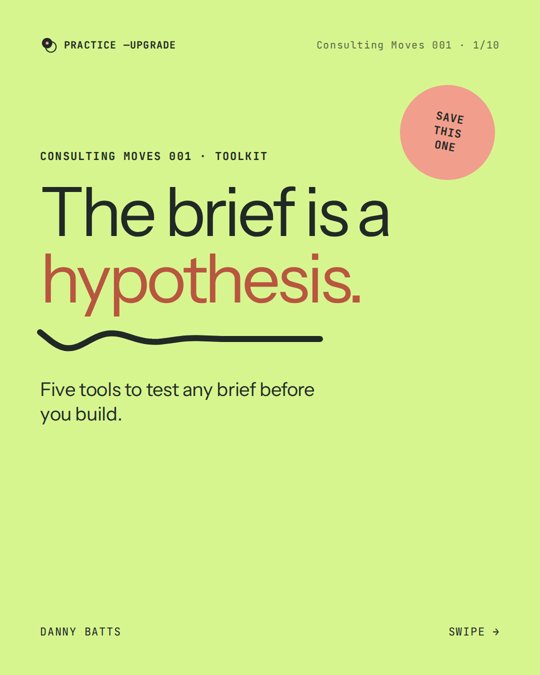
Move 001
The brief is a hypothesis.
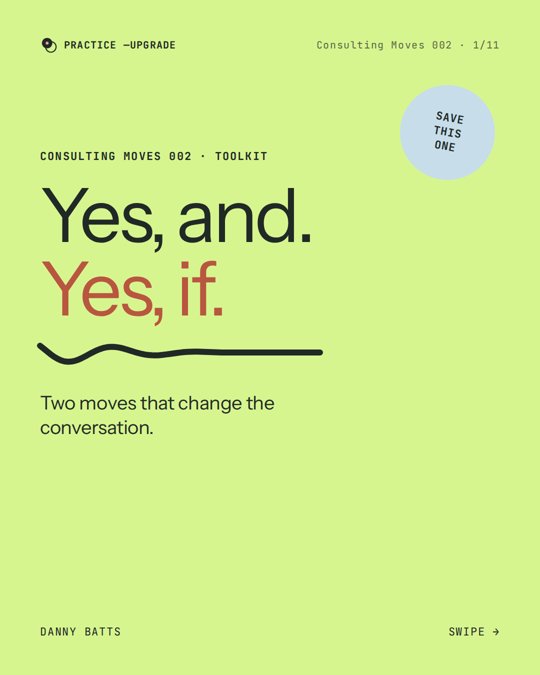
Move 002
Yes, and. Yes, if.
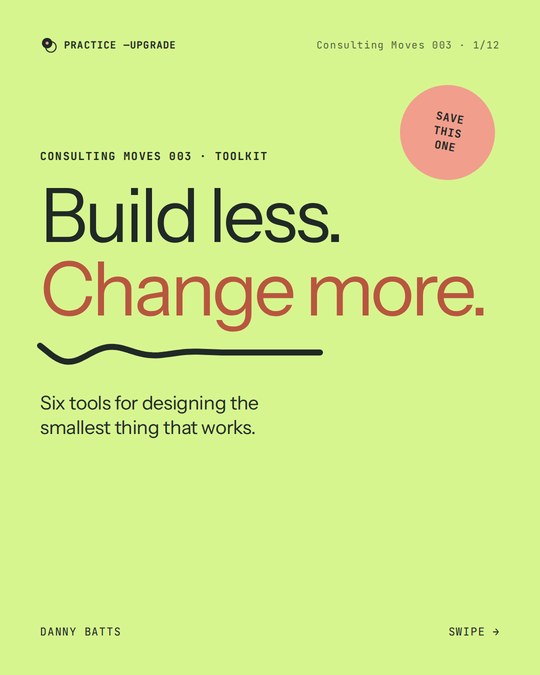
Move 003
Build less. Change more.
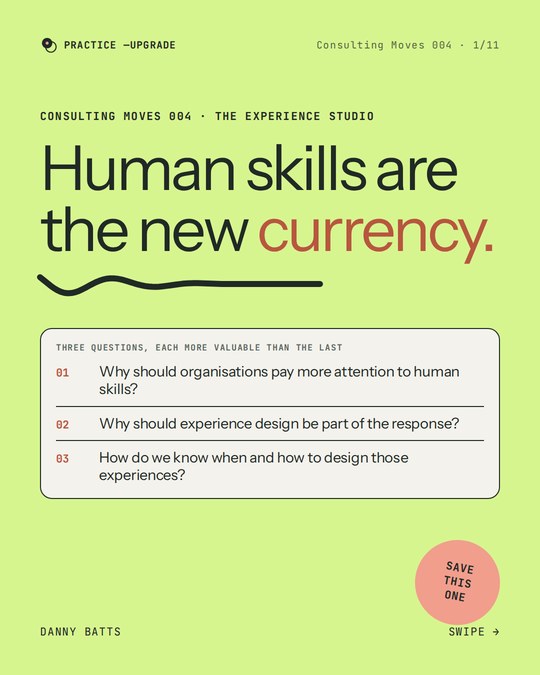
Move 004
Human skills are the new currency.
Move 005
Size the response to the gap.
Move 006
Design for the doing.
Upgrade skill 01 · Test the brief Load the method's first moves into your AI assistant. Get the skill file ↗
Bring me a request.
A brief that doesn't feel right, or a gap worth sizing. I'm always up for the conversation.
Email me the request